
Teaching reactor
The Simplest Layout and Test Results
The Simplest Layout and Test Results
This device is the result of decades of development. The electric circuit is simple, but it took years to find it, then a further year to find the optimal parameters for its parts. However, it is not the final one, there will be several improvements later.
The circuit comprises:
Capacitors: CO as buffer 1nF. C1 relaxation 75 pF. C2 catching 200 nF.
Resistors: R1 200 kΩ, relaxation resistance. R2 1.3M ohm, load. Both resistors are part of a calorimeter, to measure input and output energy. (See Fig. 1)
The calorimeters are calibrated by DC power supplies. For R1 a simple lab power supply will do, for the load R2 a high voltage (up to 2 KV) power supply will do. There is a small inductivity, 10 mH between R1 and C1. Its purpose is to mitigate power pulses from the cathode of the tube reaching R1 input resistors. Otherwise, the output pulses would be added to the input, distorting the energy balances. Moreover, it mitigates the current from the power supply buffer capacitor Co, to charge the reactor tube during the sparking. (See Fig. 2 about the layout)
It is important to let only the stored charge in C1 to get to the reactor tube. This simple setup consists of three parts.
- A high voltage simple power supply (a black plastic cylinder in the device, its buffer capacitor and a simple relaxation oscillator (R1, C1). This circuit periodically stores and releases charge to the reactor tube.
- The reactor tube. This is a variable gap discharge tube, where the edges of the cathode and anode are sharp to a degree. (0.5 mm radius.) Thus the discharge will take place under 2 KV, when the pressure is less than about 0.5 bar.
- The catalytic fusion takes place in the reactor tube, mainly on the cathode, according to our experiments.
- After a week of usage (about 8h/week) one may observe fusion products, mainly carbon and sulfur, on the perimeter of the cathode.
- (See Fig. 3)
- We built hundreds of sparking reactor tubes. You may change several variables in the tube, notably:
- The distance of spark gap.
- The pressure inside the tube.
- Gas composition.
- Voltage between the electrodes. The voltage on the input side is regulated by a small variable DC-DC converter. The simplest case uses four AA batteries. A small variable lab power supply is better. A stable high voltage power supply is the best but it can be lethal in the hands of untrained persons.
Do not use the small high voltage power supply alone without a load. Note: the maximum input voltage should not exceed 3.7 V. It will yield a very high voltage.
They represent a vast ocean of parameters. We recommend to start the tests at the following parameter ranges.
- Distance: 0.5<d<1 mm
- Pressure: 0.2<p<0.6 bar, but you are free to explore even above atmospheric pressure
- Gas composition: wet hydrogen/deuterium, carbohydrate, notably butane, or wet air.
- Voltage: 1500 V<U<2500 V. Higher voltages are not recommended due to electrical insulation problems.
The energy, gained in the tube is released both on the cathode and the anode. In our simple circuit, the energy is collected from the anode. The energy pulses from the anode go through the output load R2, and are partly stored in capacitor C2. This simple system already behaves in an unexpected manner!
The electric energy captured in C2 is eventually dissipated into heat on R2. However, C2 captures only some (about half) of the energy pulse, thus the efficiency of the process is improved. The rest of the pulse energy is radiated away.
The operation of the driven reactor.
The C1 relaxation capacitor is charged through R1 ohmic resistance, which is a calorimeter itself depending on the values of C1 and R1, and the power supply voltage. The charging can be “slow” when the discharge threshold value is just under the power supply voltage. (As mentioned before, the electrode gap distance and the pressure are optional in our reactor; one may tune it. We recommend playing with them!)
The radius of the cathode tube parameter is about 0.4 mm, a fixed, given value. It has also a crucial parameter upon the voltage threshold, where the spark jumps between the electrodes.
Note: if the voltage of the power supply is just barely above the critical threshold sparking value, the charging period is extremely erratic, random.
In this case, the discharge periods are so random that there can be at least a fivefold difference between the shortest and longest charging periods.
The charge/discharge period becomes more and more regular when the power supply voltage is gradually increased. When the power supply voltage is about twice as much as the power supply, the discharge periods are quite regular.
However, by then most of the input electric energy is dissipated on the input ohmic resistor, R1.
The ideal case is when the time constant (Ď„- tau) is roughly around 4 to 5. In this case, the same amount of energy is dissipated on R1 as relaxation resistance, since much potential energy is stored in capacitor C1. (See Fig 2) However, discharges become irregular in this case.
The source of the irregularity is dirt and minor irregularities on the cathode surface. One may eliminate them with extreme attention to surface cleaning, but it is not worth the effort. A good compromise is to keep the Ď„ (tau, rise time constant) in Fig. 2 at about 4, when the ratio between the input (dissipated) and stored energy is about 0.95.
There is a 10 mH inductivity between the R1 ohmic resistance and C1 relaxation capacitor. While this capacitor is charged, the inductivity doesn’t influence this process. Its role is to prevent the discharge pulse by the reactor tube to get back to the power supply. Thus the R1 is not heated by the pulse of the discharge tube. This small 10 mH inductivity can not prevent the power pulse to charge C1 relaxation capacitor, as we observed regularly.
As the discharge period of C1 relaxation capacitor is very short, its frequency components are very high; thus its resistance is also high.
There is a diode D1 between the power supply and the resistance R1 also. However, it is only a safety feature.
A high voltage, high current, high speed diode would be ideal at this place, but there is no such device; thus diode D1 is a compromise.
Thus L1 inductivity and D1 diode are not considered when the input/output energy balance is measured. (See Fig. 4)
Input/output power measurement
The main advantage of resistors/calorimeters for input/output energy measurements is that they are able to absorb arbitrary pulses, and turn it into heat. Heat is dissipated, then averaged inside the calorimeter. Calorimetry of the output is a standard research tool in LENR research, only the input calorimetry is unusual.
Since the resistors are quite different, they must be calibrated by different power supplies.
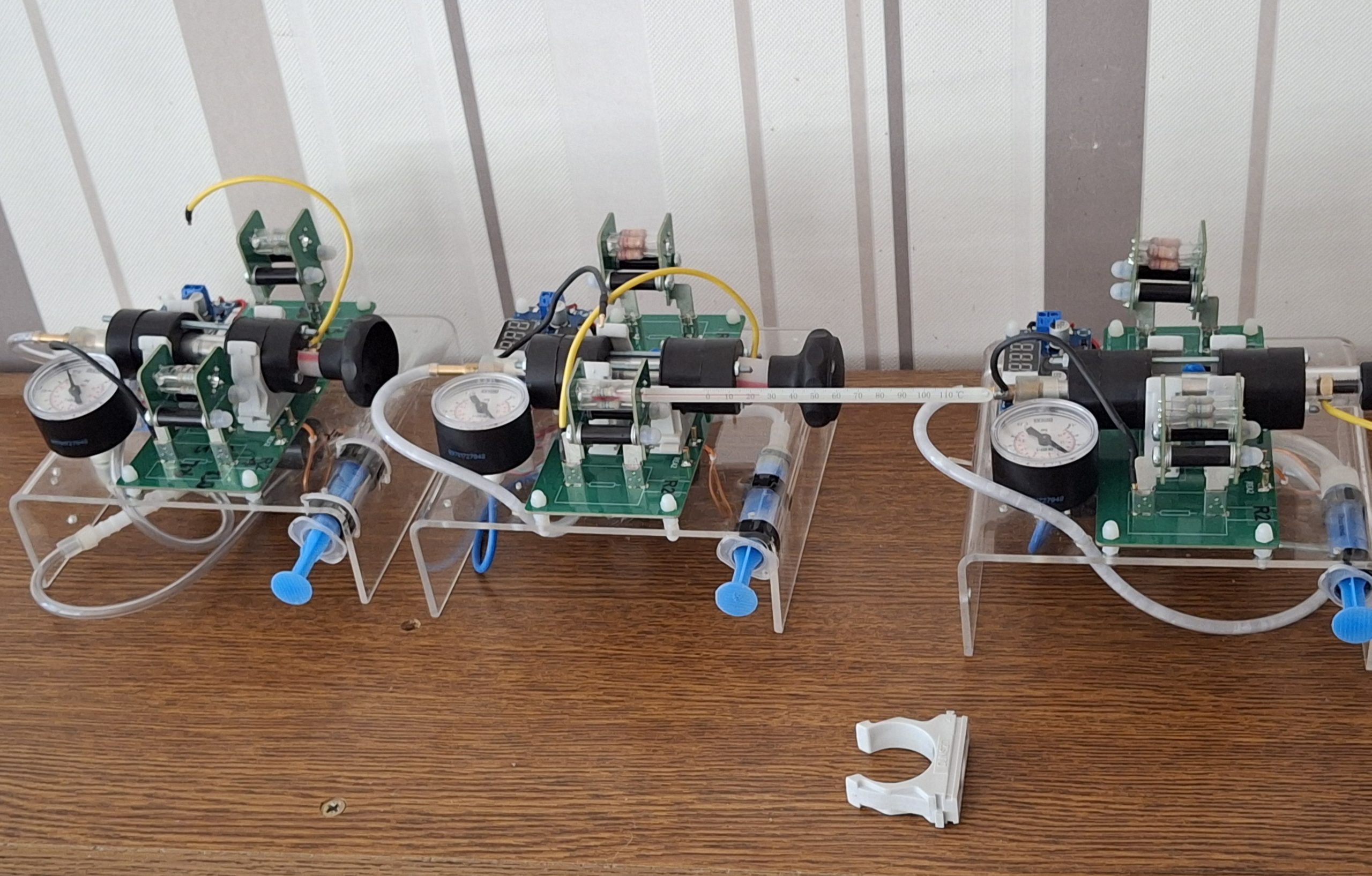
The photograph of the device is visible in Figure 3 .
The two thermometers are quite apparent.
The input resistance is 200 kOhm, and it contains two (or three) serial ohmic resistors, surrounding the bulb of the thermometers.
The size and weight of both input and output resistors are the same. They are made of an evaporated metal layer on a ceramic body. Only their thickness is different, but their weight/heat capacitance are practically identical.
From the beginning, we strove to develop a simple test method, where the input and output energies are easy to read, and compare, without cumbersome calculations. At first, we used small glass calorimeters (double walled) immersed in silicon oil. However, accidental seepage (turning over) was frequent, and the table was covered with oil.
Thus, we used a solid state calorimeter from then on. Usually, the resistors were glued to the sensor bulbs of the thermometers by a heat conducting resin.
It is white, non transparent so it is invisible and the results are misleading if the ohmic resistors are damaged,. Only a repeated calibration can decide.
We used alcohol-based thermometers for two reasons:
- They are sturdy and reliable.
- They are insensitive to external pulses. Electromagnetic sensors were useless in the presence of sparks, as their digital processors are useless near spark generated voltage transients.
(In fact, longitudinal – not transversal – waves are generated in sparks)
We provided an ohmic resistor parameter set, where the input and output temperatures are proportional to the input and output power, at about 22 mW/°C.
That is, each centigrade of temperature increase corresponds to 22 milliwatts of electric power through both the input and output calorimeters.
This is true only for the given thermal insulation. We built over 50 different types of calorimeters. The sensitivity of the calorimeters can be increased with a slightly better heat insulation. However, it has two drawbacks:
- The time constant increases, that is, the time period of the equilibrium condition is longer, as the slope of temperature rise time curve is smaller.
With the calorimeters given in the device, there is an approximately 20% error (underestimation of the power) if only a 10 minutes test period is used. There is an approximatively 5% underestimation at a quarter hour test period. However, it is not easy to keep the pressure constant for more than half an hour!
- The maximum temperature (100 °C) is another upper limit for the given calorimeters. This limits the maximum power on both the input and the output sides.
We blew over 200 thermometers due to occasional power increase at higher pressures and input voltages during the development. There were mercury-based lab thermometers as well. They are bulky, long (hard to ship and pack), expensive and too slow for practical applications.
Thus, the calorimeters are the result of about two years of optimization.
The input calorimeter can be calibrated by a low voltage (up to 30 V) standard DC power supply, where the current and voltage can be either measured or shown on the power supply.
The output calorimeter is harder to calibrate, due to its higher resistance of 1.3 M ohm.
For that purpose I recommend a 2 KV stable DC power supply which is more dangerous. All in all, the power range of the study and demonstration reactors is limited by the thermal limit of the given alcohol based thermometers.
The calibration curve is taken by a step by step process, gradually increasing the input DC power. Usually 15 minutes are enough to reach a thermal equilibrium, when the dissipated heat of a resistor is equal to the heat loss via the wall of the calorimeter. Four to five data points are usually enough.
The temperature-power relation is practically linear up to about 100 °C, because natural circulation is not significant.
We advise calibrating the calorimeters on the same layout as you intend to use it, either upright, or laid horizontally on a table. The ambient temperature must be the same for the calibration and the actual tests. If the ambient temperature changes by more than 5 °C (summer/winter) a recalibration is recommended.
We calibrated the calorimeters at 22 °C.
To conclude, the input/output measurement limits the possible maximum output value. Assuming an 80 °C maximum temperature as the highest safe temperature for the calorimeter, W max = 22 mW/°C x 60 = 1300 milliwatts. Obviously, a different calorimeter with thin heat insulation may have 50 mW/°C sensitivity, but then its accuracy and sensitivity is lower.
All in all, the development of the input/output measurement method took about half of the R&D effort.
First we tried to measure the input and output voltage, and current and then multiply and integrate their product. It proved to be cumbersome and unreliable so we had to abandon this method.
One may learn the most about the catalytic fusion method from this setup. It is seemingly simple but the discharge tube as power generator makes it difficult to comprehend.
In general, there is no previous work on pulsed power calorimetry. There are “heat wire” power measurement methods for higher power range, let’s say about 100 Watts.
Those methods are useless here. (A resistive wire elongates due to dissipation, and the power is measured via the measurement of change in the length of the platinum wire. The device is insensitive to the pulse shape just as in out method).
There is another possible circuit arrangement, where the voltage is nearly constant on the power supply side relaxation capacitor. Then there is only a small amount of dissipation, but the amount of electric charge released to the reactor tube must be controlled by an electronic circuit. However, its complications disturbs the understanding of the basic phenomena of the reactor tube.
The calorimetric method has about a 5% error range, under the given parameters, that is:
- voltage: max 3 kV
- pressure: max 0.4 bar
- electrode gap distance: max 1 mm.
See Photo 5 for the calibration curve and the photo of a calorimeter.
A typical test run
We used only high voltage probes for our tests. All attempts to measure currents failed, because the current changes by several orders of magnitude. Thus several types of coaxial current probes ought to be used, each requiring a separate oscilloscope channel.
The usual voltage (as a function of time) is shown in Fig 4.
Two voltage curves are shown which are the voltages of C1 input and C2 output capacitors, relative to the ground, as a function of time.
We used a Hantec oscilloscope, 100 MHz nominal maximum reliable frequency range. The input capacitor voltage (75 pF) is shown on the upper curve (Green).
The voltage is taken by a high voltage, high frequency probe (Testec calibrated by a Textronic probe).
It is apparent, that the capacitor is nearly fully discharged, then gradually re-charged. The periods are regular and identical.
The discharge is rapid, it is a vertical line. Even at the largest time resolution (100 Ćžsec/div) the voltage drop is vertical. That is, the voltage of the C1 relaxation capacitor is nearly fully discharged from 2300 V to 100 V. That is, nearly the whole electric power of C1 is released via the spark gap. (The pressure is 300 mbar, gap distance is 0.7-0.8 mm).
It is apparent that the Ď„ (tau) time constant is higher than 3 here. That is, the C1 capacitor is nearly fully charged during a time mesh, that is,100 microseconds after the discharge.
Then the time rise constant is about 4.
In this case, the heat release in the input calorimeter is about the same as the electric potential energy stored in C1.
In this case, the voltage of power supply is just above the ignition threshold, thus the charge time periods are quite random. The case of Fig 4 (the regular periods) is unusual. Therefore calorimeters are required to integrate the power over time.
In this case, there was a 1.7 V power supply voltage to maintain 2300 V input voltage for the C1 capacitor before the discharge.
We encourage you to explore a wide range of parameters to understand the characteristic system behavior. Note: the change of one parameter will change the rest of the parameters! At this set of parameters the frequency is about 2.5 kHz.
The lower curve on the oscilloscope is the anode capacitor voltage. C2, see Fig 1. We used two cases for load:
- a) An ohmic load for the small demo reactor.
- b) A capacitor Câ‚‚ connected parallel to the ohmic load Câ‚‚. This was only for the larger study reactor.
It is apparent, that the C2 “capturing” capacitor has a much lower voltage, but obviously it has the same frequency.
When the C2 is omitted, the shape of the load curve is quite different, because the reactor tube is discharged at a slower rate. The capacitor helps to extract more energy from the tube, because the C2 capacitor is able to absorb more energy during the brief sparking.
Our option is thus the extraction of capacitive energy, though inductive capturing is also an option. However, the distributed capacity between the wires may dissipate more energy than a purely capacitive energy extraction.
The ratio of C1/C2 is an important factor. (Those having a study reactor are able to change C2 easily, thus they are able to test the effect of the capacitance value).
The room temperature was 25 °C during the test (Fall 2024). The input thermometer rose to 30 °C at equilibrium (Temperature rise: 13 °C). The output thermometer rose to 52 °C, (temperature rise: 27 °C). In this device the calorimeter coefficients were only 17 mW/°C, in order to accelerate test times.
Thus at the input, the dissipated (and stored at C1) power was dTâ‚: 13 x 17=221 mW.
At the output side dT₂ is 27 °C, thus the dissipated output on the calorimeter at equilibrium is 490 mW. Thus the COP is 2.3.
This is an optimum (maximum) value, its value is less at other parameter. Especially at long discharge gap lengths the COP lengths the COP is well below 1.
Control tests
We made a number of control tests during the R&D work. Some will be tested here.
- Using inert gases, like Nâ‚‚, A, COâ‚‚. When the tubes were continuously flushed through the above gases, there were no excess energy results. When they were just sealed, the ambient air and humidity diffused through the cracks of the sealing. Then efficiency rose to around one.
Our best results were reached with wet hydrogen. However, the above tests were achieved in damp air, as it is more convenient, faster to take a test result.
- Other metals (uncoated aluminum, iron, copper). The test results were erratic and inconclusive with these metals in general. The most important quality is surface cleanness and surface morphology even at micrometer and nanometer scales. Usually we were unable to control these parameters. This type of quality control is beyond our financial budget.
- Short circuit instead of the reactor tube.
This is also an important control test. However, this is possible when pulsed current is provided by a different circuit, made for this purpose.
The relaxation circuit can’t use a shorted tube, as there are no pulses, just DC.
Power leakage and losses.
There are two known sources power loss:
- Longitudinal waves generated by sparking. It can be detected by several neon tubes that are laid in the vicinity of the reactor tube.
The results are mixed. Sometimes even three long (1m) neon tubes are slightly lighted. The amount of leaked power cannot be determined. It can be in the same order of magnitudes as the dissipated (extracted) power.
The frequent failure of digital equipment (including the telephones) is also a sign of longitudinal or scalar waves.
- Unwanted transmutation products. The cathode edge is covered by traces of carbon and sulfur after some days of operation, but there are other heavier elements like Cu and even tungsten. We cannot even estimate how much energy is spent on these unintended nuclear reactions.
- Power loss by the high voltage probe. The internal resistance is 100 M ohm. The C1 capacitor is at 2-3 kV most of the time. Thus about 50 mW loss of power is inevitable. This power is lost, because the current will not go to C1 capacitor, but it will heat the input calorimeter.
There is another independent method to measure the input/output power ratio. The input power is supplied by a 4 microfarad capacitor. This capacitor is connected parallel to the relaxation capacitor, and to the power supply as well. This way the input energy can be clearly measured. It is enough to charge and discharge the 4 microfarad capacitor about 15-20 times in order to reach a thermal equilibrium of the parameters.
The input calorimeter increases 3 degrees during this period, and the output calorimeter increases 9 degrees. The thermal properties of the two calorimeters are equal, as before.
The buffer capacitor as a source of input energy is a compromise. (A higher, maybe 10 microfarad, capacitor could supply input power for a longer time.) Anyway, the experiments should run at least as long as the calorimeters are near to equilibrium. Any error yields a conservative estimation, because the thermometers show a lower value than in case of euilibrium.
It is not worth trying a shorter period, because the error of reading the temperatures increases at smaller values. At about one degree of temperature increase, the error is significant, because only half degree °C is noticeable. Smaller temperatures cannot be observed.
The initial 1200V input is also a compromise, because the frequency of the discharges increases at higher voltages. Thus the time constant of the system decreases, and more energy is dissipated on the input relax that arrives to the input capacitor. Then the input energy calculations are more complex (though they are still feasible).
We found a good compromise at the following parameters in our case:
Starting voltage 1200V, lower than usual.