
Catalytic Fusion
No doubt it has already occupied your thoughts that the world is in great need of a new source of energy. Human activity over the past centuries has not spared natural resources.
There is a solution for relatively cheap, pollution-free energy production. After decades of research and experimental work, one such solution, catalytic fusion, has reached the threshold of becoming a reality.
The core idea and motto of the Enlightenment is just two words: Dare to know!
Catalytic fusion is about the same thing: Dare to know! Dare to think differently, better!
Catalysis is a long-established concept, widely used in the heavy chemical industry, and an indispensable part of life. Its essence is to help two substances react by lowering the threshold energy required for the reaction.
For example, hydrogen and oxygen gas coexist peacefully until a tiny spark sets off a chain reaction and the mixture explodes. But if you put a piece of platinum into the gas mixture, both hydrogen and oxygen bind on its surface, and the reaction then starts slowly, in a controlled way, without any external energy (spark). We have lowered the energy threshold!
All our life processes are based on catalysis; numerous enzymes (vitamins) operate in every corner of life.
Catalytic fusion also works along these same principles.
The basic principle of hot (controlled) fusion was taken from the operation of the hydrogen bomb, where the fusion of deuterium and tritium (heavy hydrogen) requires a very high energy threshold: about 130 million degrees. If we want to achieve the fusion of two deuterium nuclei, the energy threshold is even higher, about 500 million degrees. The fusion of two hydrogen nuclei, or perhaps boron and hydrogen, needs a still higher temperature, which is a great technical challenge and can be solved only at very great expense. There is then no question of tiny, portable reactors!
The solution is radically different from the “brute force” principle above. Our solution is a two-stage catalysis. (Blood clotting consists of 8 catalytic steps!)
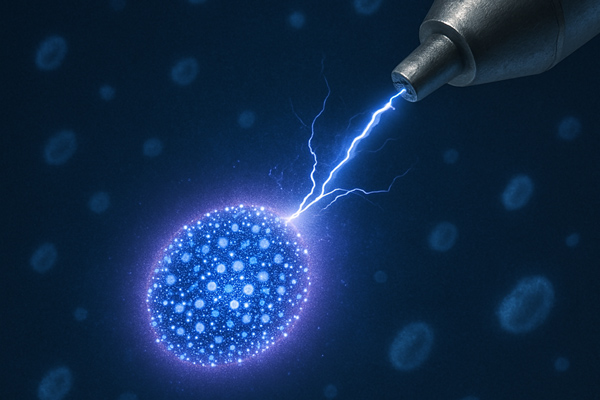
In the first step we create so-called “condensed plasmoids” in hydrogen by means of a spark discharge. These consist of electrons, about the size of a bacterium, clinging together. The point: an extremely intense electric field surrounds them. In this strong electric field the protons produced during the discharge are accelerated and, uniting (fusing) with an electron, form an electrically neutral neutron. This step still requires an energy investment (about 0.7 MeV).
In the second step the freshly created, slow neutron immediately fuses with the proton that has adhered to the plasmoid; they create deuterium. This process already releases more energy than was needed to create it. Of course further important subprocesses are also required, but the essence is the two catalytic processes above.
Unfortunately, the fusion researchers working on building the hydrogen bomb could not step out of their own narrow line of thought. They did not know biology, the multitude of catalytic processes there. Hot-fusion researchers did not dare to step out of their narrow little “box”; they do not dare to read old, forgotten patents, inventions already brought into being (Moray, Tesla, Papp, Horváth, etc.).
On this website you can read the 8-part article series previously published in Infinite Energy Magazine, which describes the theoretical foundations of catalytic fusion in detail. You will find the series in the Publications menu.