
What is catalytic fusion?
You have no doubt already been concerned that the world is in desperate need of a new source of energy. Human activity over the past centuries has not spared natural resources.
There are solutions for relatively cheap, pollution-free energy production. After decades of research and experimentation, one such solution, catalytic fusion, is on the verge of becoming a reality. The basic idea and slogan of the Enlightenment is just two words: dare to know!
This is what catalytic fusion is all about: Dare to know! Dare to think differently, better!
Catalysis is a long-established concept, widely used in the heavy weapons industry and an essential part of life. It involves helping two substances to react by reducing the level of threshold energy required to make them react.
For example, hydrogen and oxygen gas coexist peacefully until a tiny spark sets off a chain reaction and the mixture explodes. But if you put a piece of platinum into the gas mixture, both hydrogen and oxygen will bind on the surface of the platinum, and the reaction will start slowly and in a controlled way without any external energy (spark). The energy threshold has been lowered!
All our life processes are based on catalysis, with many enzymes (vitamins) at work in every aspect of life. Catalytic fusion works along the same principles.
The basic principle of hot (controlled) fusion is taken from the operation of the hydrogen bomb, where the fusion of deuterium and tritium (heavy hydrogen) requires a very high energy threshold of about 130 million degrees Celsius. If we want to achieve fusion of two deuterium nuclei, the energy threshold is even higher, around 500 million degrees. The fusion of two hydrogen nuclei, or boron and hydrogen, requires an even higher temperature, which is technically challenging and very expensive. There is no question of tiny, portable reactors!
The solution is radically different from the “muscle” principle above. Our solution is a two-step catalysis. (Blood clotting consists of 8 catalytic steps!)
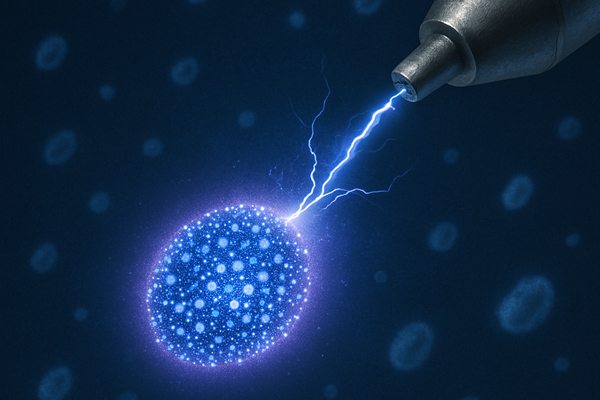
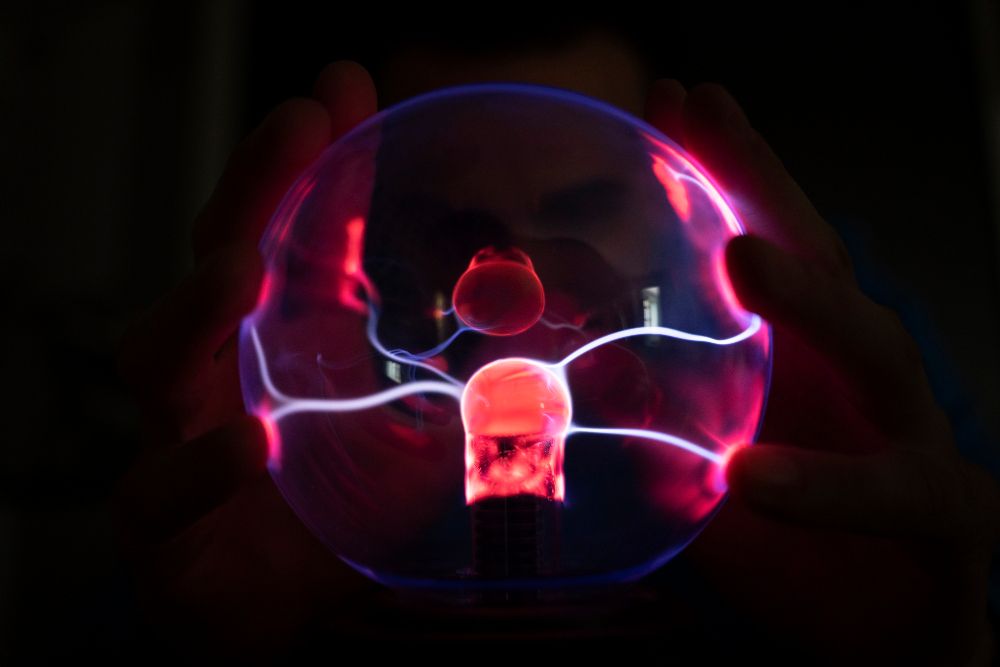
In the first step, so-called “condensed plasmoids” are created by spark ignition in hydrogen. These are made up of electrons about the size of a bacterium stuck together. The point: they are surrounded by an extremely intense electric field. In this intense electric field, the protons produced by the discharge accelerate and fuse with an electron to form an electrically neutral neutron. This step requires an energy investment (about 0.7MeV).
In the second step, the freshly created slow neutron fuses immediately with the proton trapped in the plasmoid, creating deuterium. This process already releases more energy than was needed to create it. Of course, there are other important sub-processes involved, but the main point is the two catalytic processes described above.
Unfortunately, the fusion researchers working on the hydrogen bomb could not escape their own narrow mindset. They didn’t know the biology, the myriad of catalytic processes involved. The hot fusion researchers did not dare to step out of their narrow “box”, they did not dare to read old, forgotten patents, inventions that had already been made (Moray, Tesla, Papp, Horváth, etc.)
A series of 8 articles previously published in Infinite Energy Magazine, describing in detail the theoretical basis of catalytic fusion. You can find the article series in the Publications menu.